
Think website conversion is still about button colors or A/B tests? Think again.
By 2026, website conversion optimization (CRO) has shifted from surface-level tweaks to AI-driven systems that impact everything from user experience to revenue. Here’s what you need to know before hiring a consultant:
- Old methods don’t work anymore. Generic best practices, isolated A/B testing for landing pages, and manual workflows fail to deliver results in a world where 71% of users expect personalized experiences.
- AI is the new CRO foundation. Tools now create real-time, dynamic page experiences based on visitor intent, boosting conversions by up to 23x compared to traditional methods.
- System-level optimization is key. CRO isn’t about single-page fixes anymore – it’s about aligning every step of the user journey, from ads to checkout, to eliminate friction.
- Revenue-focused results matter. The best consultants tie their work directly to metrics like Cost Per Lead (CPL) and Customer Lifetime Value (CLV), not vanity metrics.
The hard part is spotting outdated consultants who still rely on superficial strategies. Ask about their AI expertise, ability to personalize in real-time, and how they connect CRO to revenue. They should also demonstrate how to interpret A/B test results accurately to ensure data-driven decisions aren’t based on noise. If they can’t answer, it’s time to look elsewhere.
Want to avoid wasting your budget? Read on for the skills and questions that separate the best CRO consultants from the rest.
How To Optimise Your Website For Leads and Conversions (Beginner Friendly)
sbb-itb-e8c8399
What Changed in Website Conversion Optimization Since 2023
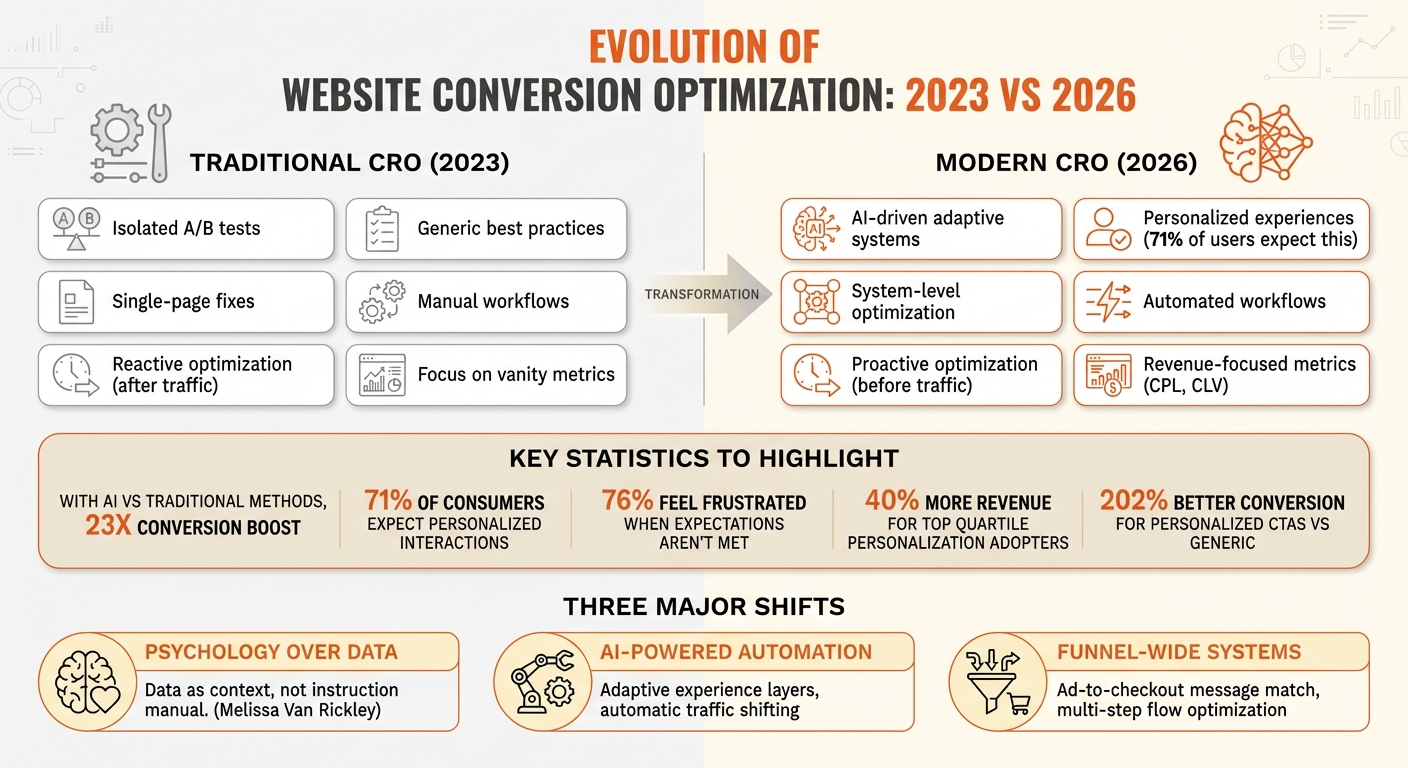
Traditional vs Modern CRO Methods 2023-2026 Comparison
From 2023 to 2026, website conversion optimization evolved dramatically. What was once a collection of isolated tactics has shifted into AI-driven systems capable of adapting in real time. Three major changes now define how optimization works, laying the groundwork for strategies that rely on AI and a more fluid, systemic approach.
Why Traditional CRO Methods No Longer Work
The old methods – like isolated A/B tests, minor design tweaks, or generic "best practices" – fall short in today’s landscape. Why? Because 71% of consumers now expect personalized interactions, and 76% feel frustrated when those expectations aren’t met [6].
At the same time, rising customer acquisition costs have made it clear that static, data-only tactics are no longer enough. Instead, strategies informed by psychology and user behavior are essential [2]. Melissa Van Rickley captures this shift perfectly:
"In 2026, high-performing CRO teams no longer treat data as an instruction manual. They treat it as context" [2].
The traditional approach – blindly following metrics without understanding user intent – has been replaced by strategies that dig deeper. They focus on why users hesitate, not just where they click.
Another flaw in older methods was the reactive mindset: teams waited until after driving traffic to address conversion issues. By 2026, optimization starts earlier. Sites are now built to convert effectively before traffic dollars are spent [3].
How AI Changed Testing and Optimization Workflows
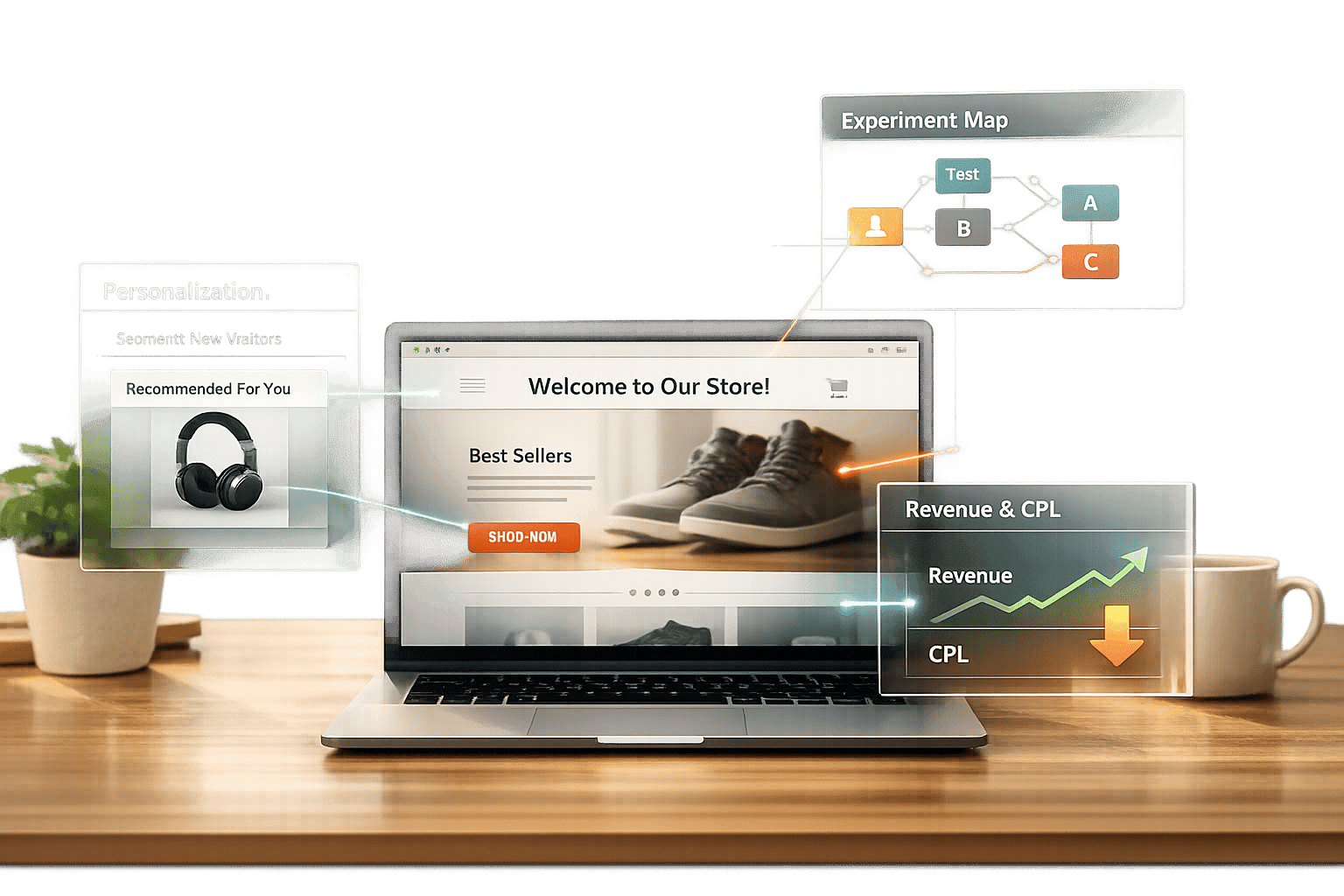
AI has completely redefined how testing and optimization are carried out. It has removed the bottlenecks that used to slow down the process of identifying opportunities and deploying changes at scale. Today’s platforms use adaptive experience layers, where AI detects visitor signals – like traffic source, location, or intent – and adjusts the page experience in real time, even before the page loads [6].
Meenal Chirana from Fibr AI explains this evolution:
"Modern CRO in 2026 is shifting from one-off changes to experiences that adapt to signals automatically, so improvements compound instead of resetting every week" [6].
AI ensures that optimization insights don’t get stuck in manual queues. It can implement changes across hundreds of URLs simultaneously, allowing improvements to build on each other rather than starting over with every test.
Adaptive testing has also replaced the old manual process of declaring winners. Platforms like HubSpot now automatically shift traffic to the best-performing variations without human input [5]. AI takes this further by analyzing massive datasets to spot subtle friction points – like trust issues or cognitive overload – that might escape human analysts [2][5]. Tools such as Fibr’s Genesis even generate on-brand landing pages from minimal input, cutting the time to launch segment-specific campaigns from weeks to just hours [6].
The Shift from Single-Page Fixes to System-Level Optimization
The focus has moved beyond individual page tweaks to optimizing entire conversion systems. Modern strategies ensure a seamless message match from the initial ad to a frictionless checkout, maintaining consistency across multi-step flows and varied traffic sources [1][6].
This system-level approach treats URLs as dynamic. Pages now adapt to different user contexts, ensuring the journey – from ad click to checkout – feels cohesive and intuitive [6].
The results speak for themselves. Businesses in the top quartile for personalization generate 40% more revenue from those activities compared to slower adopters [6]. Personalized calls-to-action convert 202% better than generic ones [6]. These outcomes aren’t just about refining single pages – they’re the result of orchestrating adaptive systems that smooth out the entire user journey.
What Website Conversion Optimization Should Include in 2026
As technology evolves, website conversion optimization in 2026 has shifted from isolated tactics to a system-level approach. These strategies now rely heavily on AI-driven methods, integrating personalization, rapid experimentation, and measurable business impact into a cohesive framework.
AI-Powered Personalization and Audience Targeting
By 2026, personalization has become smarter and more responsive. It’s no longer about sprinkling in a visitor’s name – it’s about adapting in real time to factors like search intent and device type [6][7]. Visitors now expect websites to deliver tailored experiences instantly, without delays or irrelevant content [6].
Modern platforms use AI to create dynamic, adaptive page layers. For example, URLs act as intelligent agents, customizing pages for each visitor. A healthcare buyer might see hospital case studies, while a real estate professional is shown property management examples – all on the same URL [6].
A practical example of this is David.AI, which in January 2026 personalized headlines and case studies based on industry. This approach reduced bounce rates by 42% and increased demo requests by 31% [8]. Such tailored strategies highlight why personalized calls-to-action perform 202% better than generic ones. Companies embracing these methods generate 40% more revenue from personalization compared to slower adopters [6]. As LinkedIn aptly states:
"Conversion is becoming less about persuasion and more about precision, delivering the right information at the right time, without friction." – LinkedIn [7]
This precision also lays the groundwork for targeted experimentation.
High-Velocity Experimentation Across Multiple Segments
In 2026, speed is a competitive advantage. The top-performing teams run hundreds of experiments annually, creating a system where small improvements stack up over time [6]. This process focuses on micro-conversions – like boosting add-to-cart confidence or streamlining checkout flows – across diverse user segments and channels. For instance, B2B SaaS companies experiment with pricing transparency and technical reassurances at various stages of the sales cycle [1][3].
Simple changes can yield big results. Reducing form fields significantly improves conversion rates [6], while landing page copy written at a 5th to 7th-grade reading level converts at 11.1%, compared to 5.3% for professional-level content [6]. Even a 100-millisecond improvement in page load time can lead to a 1% increase in revenue [6].
Consultants use prioritization frameworks like ICE (Impact, Confidence, Ease) or PIE (Potential, Importance, Ease) to focus on high-return experiments. The best-performing SaaS companies achieve conversion rates of 11.6%, far surpassing the 6.6% median across industries [6]. While these experiments drive incremental improvements, their true value lies in their measurable contribution to business growth.
Measurable ROI and Direct Business Impact
Conversion optimization in 2026 isn’t just about improving metrics – it’s about driving revenue. The focus has shifted from vanity metrics to direct financial outcomes [1][3]. As the saying goes, fixing friction before scaling traffic is like patching a leaky bucket before adding water [1].
Smart companies are reallocating ad budgets to address conversion barriers first. For example, improving a conversion rate from 2% to 3% results in a 50% increase in conversions without additional traffic [3]. This also reduces Cost Per Lead (CPL) by 33% [5].
Modern consultants track metrics that matter, such as CPL, Pipeline Velocity, Revenue Per Visitor (RPV), and Customer Lifetime Value (CLV) [5][6]. With 70.19% of online shopping carts abandoned – representing $260 billion in lost orders annually across the US and EU [6] – there’s a clear financial incentive to optimize. As Mike Gingerich puts it:
"The brands that win in 2026 are not the ones spending the most. They are the ones removing the most friction before they spend." – Mike Gingerich [3]
If a consultant can’t connect their work to your bottom line, they’re falling short. Outdated models focused only on page-level tweaks are no longer enough. In 2026, conversion optimization is about aligning strategy with measurable business outcomes.
Warning Signs: How to Spot Outdated CRO Consultants
When evaluating consultants in 2026, be cautious of those clinging to outdated tactics from 2022–2023. These red flags can reveal inefficiencies that could cost your business results.
As the field of website conversion optimization continues to evolve, outdated practices often signal consultants who are not keeping up with the latest methodologies.
Still Relying on Manual Testing and Page-Level Tweaks
Beware of consultants who focus on superficial changes like "button-color tweaks" or isolated page adjustments. This approach is outdated and misses the bigger picture of effective CRO [4]. Starting with A/B tests instead of behavioral research is another misstep. Testing should validate hypotheses rooted in user psychology, not act as a discovery tool. As one expert notes:
"Testing came later as a validation mechanism, not a discovery tool. When CRO starts with experiments instead of behavior, teams test endlessly – and learn very little." – melissavanrickley, CRO Digital Marketing [2]
Another pitfall is the "Zara Trap", where consultants suggest imitating competitors like Zara or Amazon without recognizing that these brands succeed due to their pre-established trust and scale, which may not apply to your business [2]. Effective consultants focus on optimizing the entire funnel – from sales calls to post-purchase retention – rather than just tweaking individual pages [1].
No Experience with AI Tools or Personalization
If a consultant’s idea of personalization is limited to adding first names in emails or basic geo-targeting, they are behind the curve [7]. By 2026, real personalization means leveraging AI to adapt in real time based on user behavior during a session – not just relying on past purchase data [7].
Take the example of a B2B SaaS startup in February 2026. Using an AI tool called Lovable, they tested 12 different value proposition variations. This approach delivered a conversion rate increase from 8.2% to 18.7%, a 128% improvement, compared to their previous agency-built site with just two variations [10].
Ask how consultants use AI for layout generation, automated accessibility, and real-time UX improvements. However, relying solely on AI for tasks like copywriting shows a lack of depth [9]. Additionally, watch for consultants who are "data-led" rather than "data-informed" – those who obsess over vanity metrics without understanding why users drop off [2].
Without advanced AI integration, consultants limit both personalization and the ability to drive meaningful revenue.
Can’t Connect CRO Work to Revenue Metrics
A major warning sign is a consultant who cannot link their work to financial outcomes. In 2026, CRO isn’t just about running experiments; it’s about reducing costs like Cost Per Lead (CPL) and Customer Acquisition Cost (CAC) while driving sales pipeline revenue [5]. Weak CRO forces teams to compensate with higher ad spend, which is unsustainable [1].
Ask how they measure metrics like Revenue Per Visitor and whether they segment conversion data by traffic source or customer quality [5][6]. Effective consultants prioritize high-ROI tests over "busy work" [6]. For example, a shift from a 2% to a 3% conversion rate can reduce CPL by 33% [5], while improving page load speed by just 100 milliseconds can increase revenue by 1% [6].
"When CRO is weak, teams compensate with spend. When CRO is strong, spend becomes a multiplier." – CRO Digital Marketing [1]
Old-school consultants treat CRO as an afterthought, something to tweak post-launch. Modern consultants, however, see it as "Advertising Readiness" – ensuring your site is optimized to convert traffic before scaling ad spend [1].
How to Choose a Website Conversion Optimization Consultant in 2026
When selecting a consultant to optimize your website conversions, it’s crucial to assess their technical know-how, strategic thinking, and ability to tie conversion rate optimization (CRO) efforts directly to revenue. The gap between forward-thinking practitioners and those clinging to outdated methods has never been more apparent. Use these criteria to guide your decision-making and ask the right questions.
Required Skills and Experience
A strong consultant in 2026 should have a solid foundation in AI-driven tools and techniques. They should clearly explain how they use AI for tasks like prompt-driven research, optimizing large language models (LLMs), and automating test variant creation – not just for generating content [12]. In fact, a 2026 survey revealed that 81% of SEO and CRO professionals ranked GEO and AI search optimization among the top three skills for the year [12].
Behavioral psychology is another key differentiator. The best consultants don’t just analyze data – they understand the why behind user behavior. They should be able to pinpoint reasons for user drop-offs, such as cognitive friction, and apply these insights to improve the user experience. As one expert puts it:
"CRO is ultimately applied psychology. Your funnel is a sequence of micro-decisions… If those aren’t answered quickly, shoppers default to the safest decision: leaving." – CRO Digital Marketing [1]
Additionally, consultants must connect their CRO strategies to meaningful sales metrics like SQLs (Sales Qualified Leads), opportunities, and closed revenue. For example, in 2025, B2B agency Directive ran a targeted experiment on a high-intent page, generating $112,000 in revenue within 30 days [11]. Look for consultants who can share similar results, complete with specific revenue figures.
Technical skills are more critical than ever. Ask about their experience with privacy-first strategies using first-party data, adaptive designs that adjust layouts in real time based on user intent, and their understanding of full-stack marketing. This includes UX, accessibility, content design, and multichannel discovery [12][7]. Their data analysis expertise should extend beyond Google Analytics 4 to tools like Python for handling large datasets and CRM platforms for precise revenue tracking [12].
Questions to Ask Before Hiring
To gauge their expertise, ask questions that reflect the modern CRO landscape:
- "How do you implement in-session personalization that adapts to real-time user behavior instead of relying solely on historical data?" [7]
This ensures they’re focused on dynamic, adaptive strategies rather than one-size-fits-all solutions. - "How do you use AI to accelerate test variant creation and identify friction points?" [13]
Ask which prioritization frameworks they use, such as ICE (Impact, Confidence, Ease) or PIE (Potential, Importance, Ease), and how they foster a culture of continuous testing [4]. For instance, SaaS company UpperHand replaced its "Request a Demo" call-to-action with an interactive tour using Navattic, leading to a 127% increase in qualified leads and a 23% shorter sales cycle in early 2026 [8]. - "How do you connect conversion improvements to metrics like Cost Per Lead, Customer Acquisition Cost, and Sales Pipeline Velocity?" [5]
Request examples of comprehensive reporting that tracks leads from the first click to a closed deal. With poor data quality costing companies an average of $12.9 million annually, ensure they have processes to maintain data integrity [4]. - "How do you interpret user drop-offs?"
If their answers focus solely on issues like traffic quality or pricing without addressing unmet expectations or cognitive friction, they may lack depth [2]. Look for consultants who use heuristic analysis to evaluate value propositions, cognitive load, and visual hierarchy before launching costly A/B tests [2].
Why Data-Mania Stands Out for AI and B2B SaaS Companies
Once you’ve outlined your evaluation framework, compare consultants’ track records to these modern standards.
Data-Mania’s Fractional CMO services are tailored to AI startups, analytics platforms, and B2B SaaS companies navigating the complexities of 2026. Founder Lillian Pierson combines marketing leadership with an engineering background, offering deep expertise in data and AI consulting.
Unlike generalist consultants, Data-Mania specializes in the technical challenges and extended sales cycles typical of AI and B2B SaaS businesses. Their approach integrates technical marketing with CRO strategy, treating optimization as a foundational element that shapes product positioning, pricing, and messaging – not just a post-launch fix [2].
For companies with marketing budgets over $1 million annually, Data-Mania provides part-time marketing leadership that ties CRO efforts directly to revenue. This includes strategic planning, execution oversight, KPI tracking, and team leadership. For businesses with tighter budgets, their Power Hour advisory sessions deliver targeted, actionable advice on immediate priorities.
Data-Mania serves a wide range of tech companies, from two-sided marketplaces to DevTools, MarTech platforms, and HealthTech SaaS. They focus on businesses where technical precision and behavioral insights are key to driving conversions. Their service model acknowledges that effective CRO in 2026 demands both data fluency and psychological expertise – skills rarely combined in traditional marketing consultants.
Conclusion
By 2026, website conversion optimization has evolved far beyond simple A/B tests and minor design tweaks. The focus now is on AI-driven personalization and adaptive systems that directly influence revenue. As Mike Gingerich aptly states:
"The brands that win in 2026 are not the ones spending the most. They are the ones removing the most friction before they spend" [3].
Modern strategies prioritize measurable outcomes over outdated approaches that rely on superficial changes and vanity metrics. Today’s practitioners recognize that emotions drive decisions, with logic serving as post-purchase justification [2]. This understanding, combined with tools like AI, allows businesses to test variations at scale, eliminate friction across the customer journey, and tie every effort to critical revenue metrics such as Customer Acquisition Cost (CAC) and Sales Pipeline Velocity.
With Customer Acquisition Costs rising by 202% [14] and average website conversion rates stagnating at just 3.1% [3], it’s clear that businesses need to adapt. Hiring consultants who excel in AI-powered experimentation, real-time personalization, and revenue-focused optimization is no longer optional – it’s essential. These experts understand that conversion rate optimization (CRO) is now a strategic framework that shapes decisions around product offerings, pricing, and messaging [2]. This shift – from isolated tweaks to a system-wide strategy – defines the path to sustainable growth in 2026.
FAQs
What does AI-driven website conversion optimization actually change on my site?
AI-powered website conversion optimization moves beyond manual adjustments to embrace a more comprehensive, proactive strategy. These tools analyze user behavior, pinpoint problem areas, and implement solutions instantly. The result? Experiences that feel personalized and responsive to individual user needs, while simultaneously tackling pain points and performance issues. By accelerating testing and delivering smarter updates, AI turns your website into a dynamic platform designed to enhance user satisfaction, build trust, and boost conversion rates.
How can I measure CRO impact on revenue, not just conversion rate?
To understand how CRO contributes to revenue, consider the complete revenue formula: Revenue = Traffic x Conversion Rate x Average Order Value (AOV) x Customer Lifetime Value (LTV). It’s not just about boosting conversions – it’s about examining how CRO influences customer value and long-term loyalty. Tie your CRO strategies to key business metrics like revenue per visitor and lifetime value to ensure you’re driving meaningful ROI rather than focusing solely on short-term conversion gains.
What should I ask a CRO consultant to prove they’re modern in 2026?
Ask whether they incorporate AI-assisted diagnosis, personalization, and system-level experimentation instead of sticking to outdated A/B tests or minor page-level adjustments. Are they committed to building adaptive systems and delivering personalized experiences that drive measurable ROI? A forward-thinking consultant should emphasize trust-building, technical excellence, and strategic, AI-powered insights to spot and resolve problems before they escalate. If they can’t clearly articulate these approaches, they might not align with the expectations of 2026.